Showing posts with label Houseplant. Show all posts

Thursday, March 24, 2016

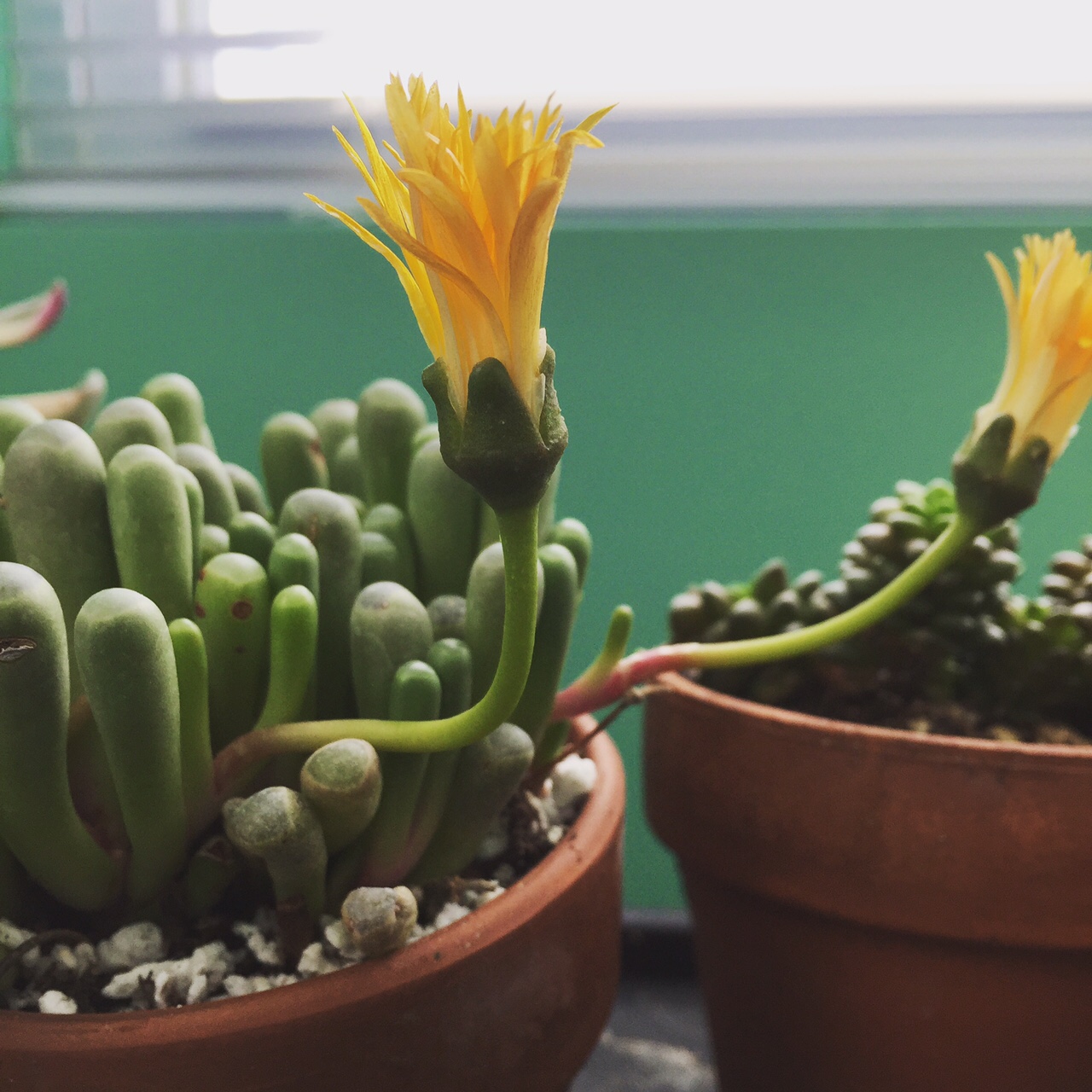
Fenestraria aurantiaca (AKA Baby Toes)

I picked up a Fenestraria aurantiaca at Home Depot late this winter. I've seen these many times before, but for some reason, it looks like a plant I have a high chance of killing. I have a very green thumb in general, but I have my limits. So far, it has done well. I was excited that the specimen I bought had some visible buds.


Here is the plant label:


Those flower buds developed and opened into these beautiful cheery yellow blooms.


So far so good, but we'll see if I can ever get it to bloom again. I'll be happy if I can just keep this little guy alive.


Monday, March 21, 2016

Kalanchoe fedtschenkoi variegata 'Aurora Borealis'

Here is yet another of the many succulents I purchased at Home Depot this winter. This one is Kalanchoe fedtschenkoi variegata 'Aurora Borealis'. I already have one of these at work, but I've had a lot of problems with that particular specimen. All of the leaf edges (specifically, where the white part is) keep burning and turning necrotic.  Maybe this is because this is a chimera? I'm hoping this new plant will have fewer problems.


Like other kalanchoes, this plant will eventually form little plantlets on the leaf margins.


And here's the tag. This specimen doesn't have as much of the pink coloration as my previous one, but then again, it has been sitting in a dim Home Depot warehouse for weeks. It'll probably color up soon.


Friday, February 26, 2016

Oxalis Pips

We got a huge bag of 1,000 Oxalis triangularis pips donated almost a year ago. They've been sitting in the cooler this whole time, but they still look viable. Some of them even have tiny light-starved shoots growing out of them.

They sold really well in last year's sale, so I potted some up for this year's sale. We can market these as both a houseplant and an annual, so I'm growing two batch for the two different displays.

I'm not sure if "pip" is the correct word, but that's what I've always heard these worm-like roots called. I also heard citrus and apple seeds called pips, so maybe it's just a general word for small seed-like thingy.


Friday, February 12, 2016

Gasteria maculata

Here's a plant I've had for quite a while. It doesn't ever seem to grow, but I suppose it has been multiplying without me realizing it. I purchased this plant at least 5 years ago from the MSU Student Horticulture Association annual plant sale fundraiser.


I should make some divisions and propagate a few more of these in the future.


Wednesday, February 10, 2016

Adromischus cristatus 'Key Lime Pie'

Here's yet another specimen I picked up at Home Depot recently. I know absolutely nothing about Adromischus cristatus, but I couldn't resist the wavy-edged leaves. I've never seen anything like it before. The common name, Key Lime Pie refer to the crinkled-edge of pie crust. Another common name is Crinkle-leaf plant or Pie Crust plant.


You can't see them very well in this photo, but there do appear to be some form of spines of fine hairs near the center of the rosette.


And here's the info on the tag.


Monday, February 8, 2016

Opuntia subulata (AKA Eve's Needle)

Don't you just love it when there's random flotsam hot-glued to your plants?  I really don't know why they do this to cacti and succulents. This plant is bizarre enough on its own, it doesn't need a silly flower to catch your attention. I especially love the hot glue tendrils that they didn't even bother to pick off. In any event, I promptly pried off the flower once I got home from the store.

This is my new Opuntia subulata that I picked up at Home Depot for $3.48. It appears to be thornless and has weird "leaves" growing out of the stem. After looking up information on this plant, it looks like it might develop needles later on in development. I guess, we'll wait and see.


Here's the label on the pot, although I couldn't fit it all in one photo:


Friday, February 5, 2016

Kalanchoe tomentosa 'Chocolate Soldier'

Here is yet another one of the succulents I recently purchased at Home Depot. This fuzzy little guy was $3.33, on sale. I've grown the regular Kalanchoe tomentosa in the past, but I've never had this cultivar. I can't decide if I actually like this cultivar better...I think I just like things that are unusual. I remember having a lot of trouble with my last specimen of Kalanchoe tomentosa, so I hope this one will be easier to grow!


Here's the description from the propagator, Altman Plants:

"Kalanchoe tomentosa ‘Chocolate Soldier’, forms a shrubby plant with long oval shaped leaves densely covered in fuzzy felt. There are many cultivars with color variants, but the “true” tomentosa has dove gray leaves with reddish-chocolate margins and tips. This cultivar, ‘Chocolate Soldier’ has chocolate-colored leaves with nearly black markings at the tips. Very attractive, rich chocolate color provides an attractive accent with other plants. Flowers are small, but are quite uniquely attractive furry, bell-shapes that are golden ginger in color. Prefers bright light to full sun. Can be planted in patio plantings or even in garden beds in areas with temperate climes. Use porous soil with adequate drainage. Water thoroughly when soil is dry to the touch. Protect from frost."


And here's the pot label:


Thursday, February 4, 2016

Crassula argentea 'Ogre Ears'

I recently purchased a specimen of Crassula argentea 'Ogre Ears' at Home Depot. Normally, I like to use plain terracotta pots, but this particular plant was calling out for something special. I've had this funky orange pot for quite a while, but I haven't used it for a few years. I'm pretty sure it's a garage sale or thrift store find.


This plant was named after the ogre's ears in the movie Shrek. The leaves are really cute and unusual. I also have a Crassula ovata 'Hobbit' that looks really similar. For the longest time, I thought they were the same plant.


The leaves of 'Hobbit' are more tube-shaped, sometimes with a little cup at the tip (see photo below). 'Ogre Ears', on the other hand, has a more pronounced, flared, saucer shape at the tip of the leaf. I think they do get mixed up a lot and are often mislabeled. But from what information I can find, they're not even the same species. To make things even more confusing, there's also a variety of Crassula ovata called 'Gollum', which looks exactly like "Hobbit'. If you know more about this, let me know!

Ogre Ears
Hobbit

Here's the label on the pot for more information:


Wednesday, February 3, 2016

Sedum adolphii 'Firestorm'

I'm loving this new sedum variety in my succulent collection. The red-orange coloration really makes it stand out. I'm hoping it will hold its color indoors.

One of my colleagues clued me in on the great selection of succulents currently at Home Depot. I've never seen so much variety at a big box store, and there were some truly unusual specimens available (more on these later). This plant came in a 3" pot and was on sale for $3.33 (normally $3.98).

Here's the description from the propagator, Altman Plants:

"Sedum adolphii, native to Mexico, forms rambling stems with waxy golden yellow leaves with pinkish-peach margins in bright light. Star-shaped white flowers. Excellent color accent in rock gardens and dish gardens. Porous soil with adequate drainage. Thrives in poor, sandy soils. Bright light to full sun. Water thoroughly when soil is dry to the touch. Protect from frost."


And here's the growing information given on the pot. I was pleasantly surprised that Home Depot was selling named varieties. Usually their indoor plants are just labeled "assorted succulent"  or "tropical foliage assortment'.


Tuesday, February 2, 2016

Simple Beauty


Clockwise from top-left: Setcreasea pallida, purple heart; Tradescantia spathacea variegata, oyster plant; Sansevieria hahnii, bird's nest snake plant; and an unknown rex Begonia

Monday, February 1, 2016

Begonias in Bloom

Our indoor begonia collection is blooming at full blast right now. These plants are mostly grown for their interesting foliage, so it's a treat to see them put on a show for us.

Here's Begonia 'Pegasus', a variety from Proven Winners. We grew this in the trial garden a couple years ago, and this plant made it's way into the greenhouse at the end of the season. We can't propagate from it because it's a copyrighted variety, but it's a fun plant to have in our collection.


These are the flowers of what I believe to be Begonia erythrophylla, or pond lily begonia. We have a lot of unlabeled plants in our collection, so I've been doing my best to identify them.


Here are the flowers of Begonia ricinifolia (again, my best guess at the i.d.), known as the star begonia.


Here's a closer look at the flower stalks of another specimen. They are just starting to open.


Now on to Begonia bowerae 'Tiger'. This plant was given to us by our perennial garden manager. She had kept it as a houseplant for many years, so it's a nice large specimen. This one has really fun foliage, so I actually think the flower stalks detract from it (and make it look a little unkempt).


I've yet to be able to identify this one. If you have any suggestions, please let me know. I'm currently calling it "the unknown sandpapery reddish green leaf begonia". It's just starting to flower, so it's a little behind the others.


Friday, January 29, 2016

Curly Locks Cactus

Epiphyllum guatamalense var. monstrose...that's a quite a mouthful of Latin nomenclature! The common name, Curly Locks, is a little easier to handle, and describes the ringlet-like, curly leaves. The Latin name is pretty informative though and tells us that this is an epiphyte from Guatemala with monstrously deformed leaves. I was recently reading about this plant in Bizarre Botanicals and learned that the leaves of this variety curl due to a genetic anomaly. Also, interestingly, this plant can produce fruit and viable seeds without being pollinated!

A colleague gave me some stem cuttings back in September 2015. They rooted very easily and started to grow new side shoots after 2 or 3 months.


The cuttings I received also had a couple of ripe fruit that resembled miniature dragon fruits (I didn't think to take a photo). I decided to see if the seeds would germinate, so I squished them out of the sticky pulp, wiped the goopy seeds onto some potting soil, and put them under the misters in our propagation greenhouse. Within a week or two, the seeds started to germinate.


The seedlings seemed to stay in the cotyledon stage FOREVER, but eventually I started to see tiny stems poking through.


Almost 4 months later, they're starting to show their curly growth habit.


And I'm extremely excited to see that they've started to grow tiny side shoots at the base of the main stem. I recently moved these from the propagation house (lower light, higher humidity), into one of our production greenhouses (higher light, lower humidity). Here's hoping the higher light levels will jump-start their growth. I would really like to get these bulked up enough to offer them at our plant sale in May.